
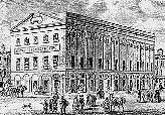
The Royal Victoria Hall Foundation dates from 1891 when it held the freehold of The Old Vic Theatre. The Old Vic Theatre opened long before this, in 1818, when it was known as The Royal Coburg. In 1833, it was renamed The Royal Victoria Theatre to honour the queen, and eventually became popularly known by its current name the Old Vic. Over the next forty years The Old Vic became a music hall and – following the fine historical examples of South Bank playhouses – was known for a place to meet people with high energy but low morals! 
In the 1870s, Emma Cons bought the theatre and reopened it as The Royal Victoria Hall, from which the charity takes its name. This was a temperance venue, a tea and coffee house. They provided entertainment but also wanted to bring education to people who were excluded from proper schooling, as so many were in the Victorian age. Lectures were held backstage. This plan was financially supported by Samuel Morley. The educational programme was a great success and eventually developed into Morley College, which still provides highly regarded courses on Westminster Bridge Road, close to the Theatre.
In 1898 Emma Cons’ niece came to work at the Theatre: Lilian Baylis, after whom the Foundation’s awards are named. Lilian Baylis is one of the most important figures in British theatre, instrumental in establishing or strongly influencing the development of the National Theatre, The Royal Ballet, English National Opera and The Royal Ballet School. Between taking control of the Theatre in 1912 and her death in 1937, she worked at the Old Vic and was devoted to bringing quality theatre to as wide an audience as possible, without regard to education, background or financial position. Baylis took over the Sadler’s Wells theatre in 1931 with the aim to make opera and dance more widely seen. It is these ambitions that The Royal Victoria Hall Foundation tries to support: helping to make theatre a valuable part of people’s lives.
 Lilian Baylis was a deeply religious woman and a notoriously hard worker. Her office was in a box to the left of the stage. From there, she was able to keep an eye on both the administrative and the artistic parts of her business. A gas ring in the prompt corner of The Old Vic stage was used to prepare her food and audiences got used to the smell of sausages, bacon and kippers in the stalls!
Hundreds of performances from most of the biggest names in world theatre have been seen on The Old Vic stage. It was the home of Olivier’s National Theatre before it moved to its purpose-built site on the river.
The Royal Victoria Hall Foundation is funded principally from the invested proceeds of the sale of The Old Vic Theatre in 1982, plus subsequent gifts and bequests. It is no longer legally or administratively connected to the modern theatre, although retains fond historical links and owns the Theatre’s archives (1918-1963) which are held at The University of Bristol Theatre collection, and holds the annual Lilian Baylis Award ceremony at The Old Vic, by kind permission of the management.


 Royal Victoria Hall Foundation